Cart ( 0 items )
Close


 Check Out
$0.00
All prices are entered excluding tax.
Excluding shipping
Delivery date: 1 week
Check Out
$0.00
All prices are entered excluding tax.
Excluding shipping
Delivery date: 1 week
Log in to your
Account
You can rate the product and share your experience
when using the product.

 Sign In

Upgrade Account
Create a request to upgrade account role become supply role to view this promotion!
Written by
tspallc
Published on
05 November, 2026


Choosing the right manicure table for your nail salon is more than simply picking a design you love. You want a set up that provides the technician enough room to work comfortably, tools and supplies close at hand, and the client the ability to sit down and get up easily. A table that appears spacious in the showroom can seem quite different when you add chairs, stools, lamps and other salon essentials.
Think about the space you have, the number of technicians working at the same time and your budget before making a decision. This guide will assist you in comparing single, double and triple manicure tables so you can select the best option for your salon based on your salon’s layout, daily workflow and future needs.
Picture two technicians working next to each other. One has a drawer full of gel pots, files and spare bulbs. The other carries a small kit and wants a clear tabletop. The same table won’t feel right to both.
Problems like this usually show up after delivery: a drawer that bangs into a stool, an outlet on the wrong side of the lamp, a gap behind the client’s chair too narrow for someone carrying a handbag. A table stays put for years, so the layout it creates is the one you live with. It’s worth working through the details before you order.
A single manicure table holds one technician and one client, and it stands on its own. T-SPA’s Vanilla Single Table is a good reference point: 42 inches long, with a built-in outlet, a storage drawer and a handrest.
Home studios (where local rules allow), private rooms and small salons tend to do well with single tables. You can set one against a wall, beside a window for natural light, or in a corner a longer table could never use. That’s often how a workable manicure station gets squeezed into a tight room.
There’s one honest drawback. Three or four single tables, each with breathing room around it, can eat more floor than one shared table of similar capacity. Sketch it on paper before assuming singles are the space saver.
A double manicure table puts two working positions on one piece of furniture. The two client seats are fixed relative to each other, so you place and move the pair as a unit. T-SPA’s Le Cinq line includes a two-client manicure table with built-in outlets.
Say a salon has one full-time technician and has just hired a second. If both are booked at the same time most days, a double table gives them a proper shared setup. If the second person only works a couple of afternoons a week, it’s a harder case to make.
Flexibility is the price. Because the positions are joined, you can’t move one into another room later. Anyone who suspects the floor plan will change within a year or two might be better off with two singles.
A triple manicure table seats three clients along one piece of furniture, and it only makes sense when three technicians can work at the same time. It isn’t automatically faster than three separate tables, a point the comparison below returns to. T-SPA lists a Vanilla Triple Table in its furniture collection.
Consider a salon where three technicians are booked together most of the day and clients arrive back to back. A triple table suits that rhythm, provided there’s a clear stretch of floor long enough for the table, three chairs and a path behind them.
Busy doesn’t always mean triple, though. A salon with a packed schedule but an awkward, L-shaped room might run better with several single tables placed wherever the room allows.
| Factor | Single | Double | Triple |
| Working positions | 1 | 2 | 3 |
| Furniture arrangement | Individual unit | Shared two-position unit | Shared three-position unit |
| Repositioning | Usually more flexible | Positions move together | Larger unit is harder to rearrange |
| Suitable layout | Separate or private stations | Paired work area | Longer shared work area |
| Staffing consideration | One technician per active position | Two for simultaneous appointments | Three for simultaneous appointments |
| Space consideration | Smaller individual footprint | Measure overall length and clearance | Requires substantial usable length |
| Growth consideration | Add individual units | Expand to a paired arrangement | Suits established multi-position demand |
Length shows why seat count isn’t the whole picture. T-SPA’s published figures put a single at 42 inches, a double at 74.5 and a triple at 106. A second seat doesn’t double the length, and those numbers cover only the furniture. Chairs, drawer swing and walking room all come on top. When you compare nail salon manicure tables from any brand, check each model’s own listing, since sizes vary between collections.
Three questions sort out most manicure table decisions: how much floor you really have, how many appointments overlap on a normal day, and what you can spend now and down the road. They’re covered here in that order.
Building and accessibility rules differ by location, so check local requirements before settling on a layout.
Three seats and three simultaneous appointments are different things. Pull up a few weeks of your schedule and note when the busy stretches hit, how long services run and who’s on shift. A salon with three technicians on alternating days might never fill a triple table. If your team rarely overlaps, separate tables or a double could match your real bookings better than the biggest option on the page.
Most manicure table setup problems show up after delivery, when changing course is expensive.
Before you buy a manicure table from T-SPA, think about what a typical day is like in your salon. How many technicians work at once, how much room do they need and what fits your budget? For a smaller workspace , one table may suffice , but a double or triple arrangement may be more practical for a team working side by side . Choose the one that fits your salon’s actual needs, rather than buying more space than you’ll use.
What is the difference between single, double, and triple manicure tables?
One, two or three working positions. A single table is a stand-alone piece, while double and triple tables are shared units, so the positions are built together and move together.
Are single manicure tables better for small salons?
Often, since one table is easier to fit around doors, corners and other furniture. Still, check real dimensions and chair clearance, because several singles can use more floor than one shared unit.
What are the benefits of double manicure tables?
Two technicians get a matching shared workspace, with one set of outlets and lighting to plan around. It works best for a pair who regularly share the same shift.
When should a salon choose a triple manicure table?
When bookings truly call for three overlapping appointments, you have the staff to cover them, and the room has enough clear length. If one of those is missing, separate tables or a double usually fit better.
How much space is needed for multiple manicure tables?
It depends on the table’s length and width, seating, drawer swing, walkways and local rules. Measure the exact model you want, then add room for chairs and for people to walk past.
OUR BLOG
tspallc • 03 November, 2026
Views: 23Are you choosing the wrong chair for nail technicians? Sitting for 8 to 10 hours daily while hunching over manicure tables or pedicure basins frequently triggers chronic lower back pain, severe neck strain, and reduced hand precision during detailed nail art or acrylic applications. When salons rely on generic office chairs with sinking foam […]
More Details

tspallc • 03 November, 2026
Views: 24CHỦ TIỆM CÓ ĐANG CHỌN SAI GHẾ CHO THỢ NAIL MÀ KHÔNG BIẾT? Việc thợ nail phải ngồi liên tục từ 8 đến 10 tiếng mỗi ngày, thường xuyên cúi gập người qua bàn manicure hay bồn pedicure dễ dẫn đến đau lưng mãn tính, mỏi cổ vai gáy và làm giảm độ chính […]
More Details
tspallc • 03 November, 2026
Views: 35Nail salon owners already run on appointments, consultations, and hands-on care, so it is natural to ask what else a spare corner or treatment room could handle. Head spa for nail salons is one idea gaining attention, since scalp cleansing, gentle massage, and a quiet, dedicated appointment offer something different from a manicure or […]
More Details
tspallc • 01 November, 2026
Views: 53Halfway through a pedicure, a technician reaches for a fresh towel and finds the stack is still in a cabinet across the room. The service pauses while they fetch it, and the same thing may happen again with the next item. A well-stocked pedicart keeps the supplies for each stage of the treatment close […]
More Details
tspallc • 30 October, 2026
Views: 68The last coat of polish is on, but the appointment is not quite finished. Moving too soon risks a smudged manicure, while staying at the manicure table can hold up the next client. A nail salon dry station gives guests a set place to sit while traditional polish dries. For owners, the question goes […]
More Details
tspallc • 28 October, 2026
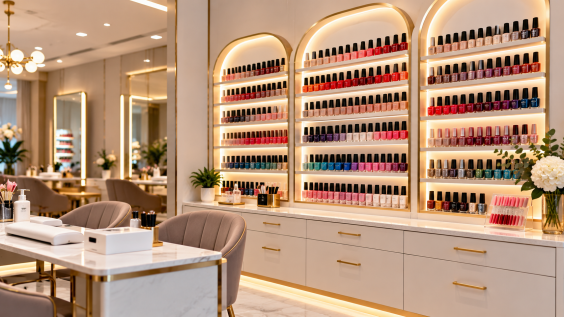
Views: 81A client asks for a soft pink, and the hunt begins. Three bottles look nearly identical, last season’s arrivals are mixed in with older colors, and the technician is checking two different shelves. A well-planned nail polish rack fixes much of that by keeping every shade visible and in a predictable spot. Where you […]
More Details
tspallc • 26 October, 2026
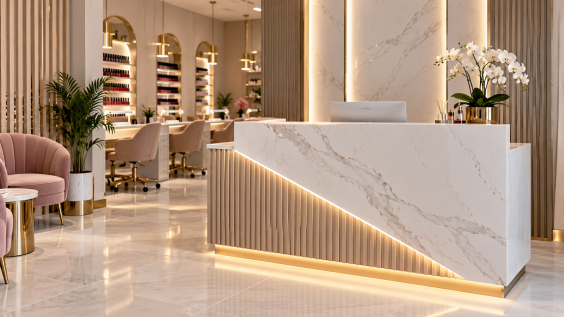
Views: 102A busy Saturday at your nail salon often begins at the front counter. One client is checking in, another is making a payment, and the phone keeps ringing. A poorly planned nail salon reception desk quickly becomes frustrating when there is not enough counter space or storage. Choosing the right desk starts with understanding […]
More Details

tspallc • 20 October, 2026
Views: 216HOW OFTEN SHOULD YOU GET A MANICURE AND PEDICURE? Getting a manicure and pedicure isn’t just a beauty luxury – it is an essential component of personal hygiene, skin health, and self-care. Whether you love maintaining flawless nail art or simply want clean, healthy cuticles and smooth heels, finding the right salon schedule is […]
More Details

tspallc • 20 October, 2026
Views: 161TẦN SUẤT LÀM NAIL BAO LÂU MỘT LẦN LÀ TỐT NHẤT? Làm manicure và pedicure không đơn thuần là dịch vụ làm đẹp cao cấp mà còn là phương pháp thiết yếu để giữ gìn vệ sinh cá nhân, bảo vệ sức khỏe làn da và thư giãn tinh thần. Dù bạn yêu thích […]
More Details

tspallc • 13 October, 2026
Views: 186HOW TO CHOOSE PEDICURE CHAIR COLORS FOR A LUXURY SALON WITH T-SPA Selecting a pedicure chair set with harmonious, sophisticated colors does far more than enhance your salon’s visual aesthetics—it acts as a subtle testament to the quality of your services, encouraging guests to confidently invest in premium spa packages. However, choosing colors that […]
More Details
tspallc • 13 October, 2026
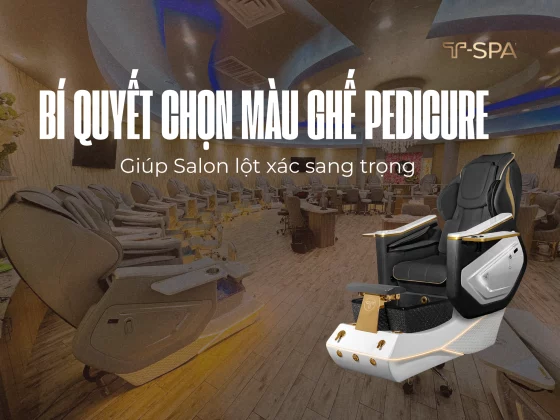
Views: 183Bí quyết chọn màu ghế Pedicure giúp Salon lột xác cùng T-SPA. Một bộ ghế có màu sắc hài hòa, sang trọng không chỉ nâng tầm giá trị thẩm mỹ cho tiệm nail mà còn là lời khẳng định ngầm về đẳng cấp dịch vụ, khiến khách hàng sẵn sàng chi trả cho các […]
More Details

tspallc • 25 September, 2026
Views: 398Long a powerful financial path for Vietnamese families, the Nail salon industry in US now faces fierce competition, shifting client preferences, and stricter State Board inspections. Outdated practices and ignored safety codes can cost clients and create legal risks. T-SPA breaks down the market, income levels, and effective growth strategies to help your salon […]
More Details